The Impact Output methodology
Before advisers. Before software.
Before the board meeting.
Impact Output maps your sustainability reporting obligations, data gaps, internal ownership, and 90-day plan — so the work that comes next actually works.
Who this is for
Built for mid-market organisations under pressure to act
Most businesses we work with arrive at the same point. The board has asked what you are doing about sustainability reporting. A major customer has sent an ESG questionnaire. An auditor has flagged climate disclosure. Or someone has come back with a consulting quote that is hard to approve before you understand what the right scope even is.
The problem is not motivation — it is clarity. You do not yet know exactly what applies, what data you hold, who owns the work internally, or what needs to happen before spending on advisers or software is actually useful. That is what Impact Output resolves.
The board asked about climate reporting and I do not have a confident answer.
We received an ESG questionnaire from our biggest customer and we are not sure what we can substantiate.
We have a consulting quote but we do not know if the scope is right before we sign.
What we cover
The full reporting landscape — not just one regulation
Most tools focus on a single framework. Impact Output maps all the obligations and commercial pressures that may apply to your business and tells you which ones matter for your specific situation — mandatory obligations, customer-driven pressure, and what you can defer.
Mandatory climate reporting for Australian entities above Group 1 and Group 2 thresholds. First reports due from FY 2024–25 (Group 1) and FY 2026–27 (Group 2).
EU sustainability reporting with value-chain obligations that reach Australian suppliers to EU customers — even without EU operations.
Climate disclosure laws affecting companies with California operations or US revenue above thresholds. Applies to Australian companies trading into the US.
The international baseline for sustainability and climate disclosure. Increasingly referenced by investors, lenders, and cross-border reporting frameworks.
Customer and investor-driven disclosure requests. Large corporate buyers are pushing emissions data requirements down their supply chains.
Legal exposure from unsubstantiated sustainability claims — separate from reporting deadlines. Active enforcement by both ASIC and the ACCC.
Not every business faces all of these. Many face more than one. The diagnostic tells you what applies to yours.
The process
Four steps. Ten days. A board-ready plan.
The free diagnostic
Answer structured questions online about your business, current reporting knowledge, data availability, and operating geography. Takes 10–15 minutes. Results emailed immediately with an initial read on what applies and what to do first. No commitment to proceed.
Pre-call intake
A short structured form completed before the strategy call. Replaces exploratory fact-finding so the call can focus entirely on decisions.
Readiness strategy call — 45 minutes
We review your diagnostic results, surface any complexity, confirm sprint scope, and answer questions. If the sprint is not the right next step, we will say so.
The 10-Day Readiness Sprint
A structured, fixed-fee engagement. We map your obligations, evidence, gaps, and ownership, and produce a complete readiness pack — including the board briefing — within 10 working days.
What you receive
Eight documents. Designed to be used, not filed.
Regulatory scope assessment
Which frameworks apply, which are mandatory versus commercial, what applies now versus later, and the consequence of inaction for each.
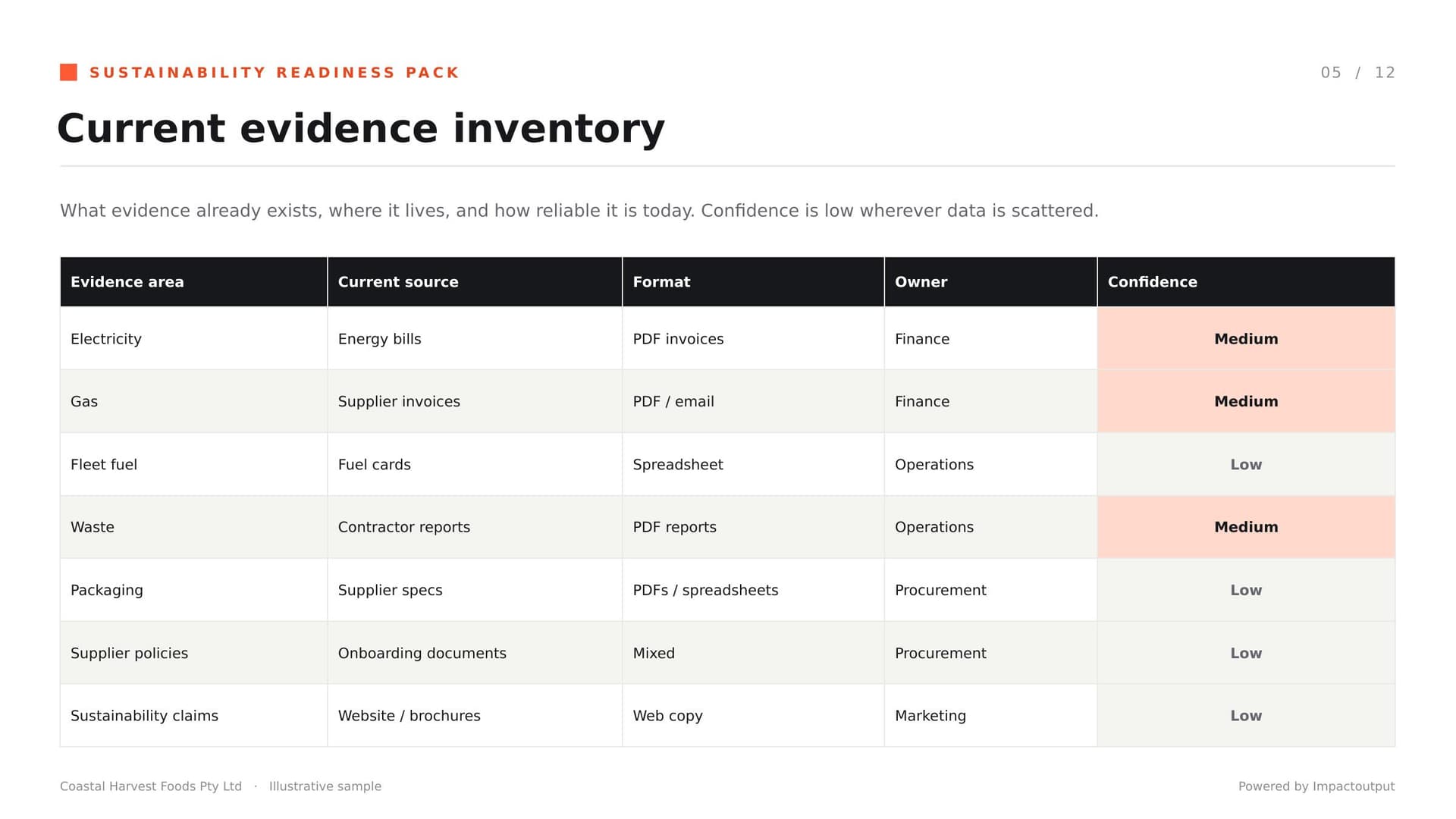
Current evidence inventory
What data you hold, where it lives, and how reliable it is — mapped against your reporting requirements by category.
Evidence gap register
The highest-priority gaps, why each matters, the risk level, and what is needed to close it.
Internal owner map
Who should own each reporting input across finance, operations, procurement, legal, and sustainability. Usually the single biggest unblocker.
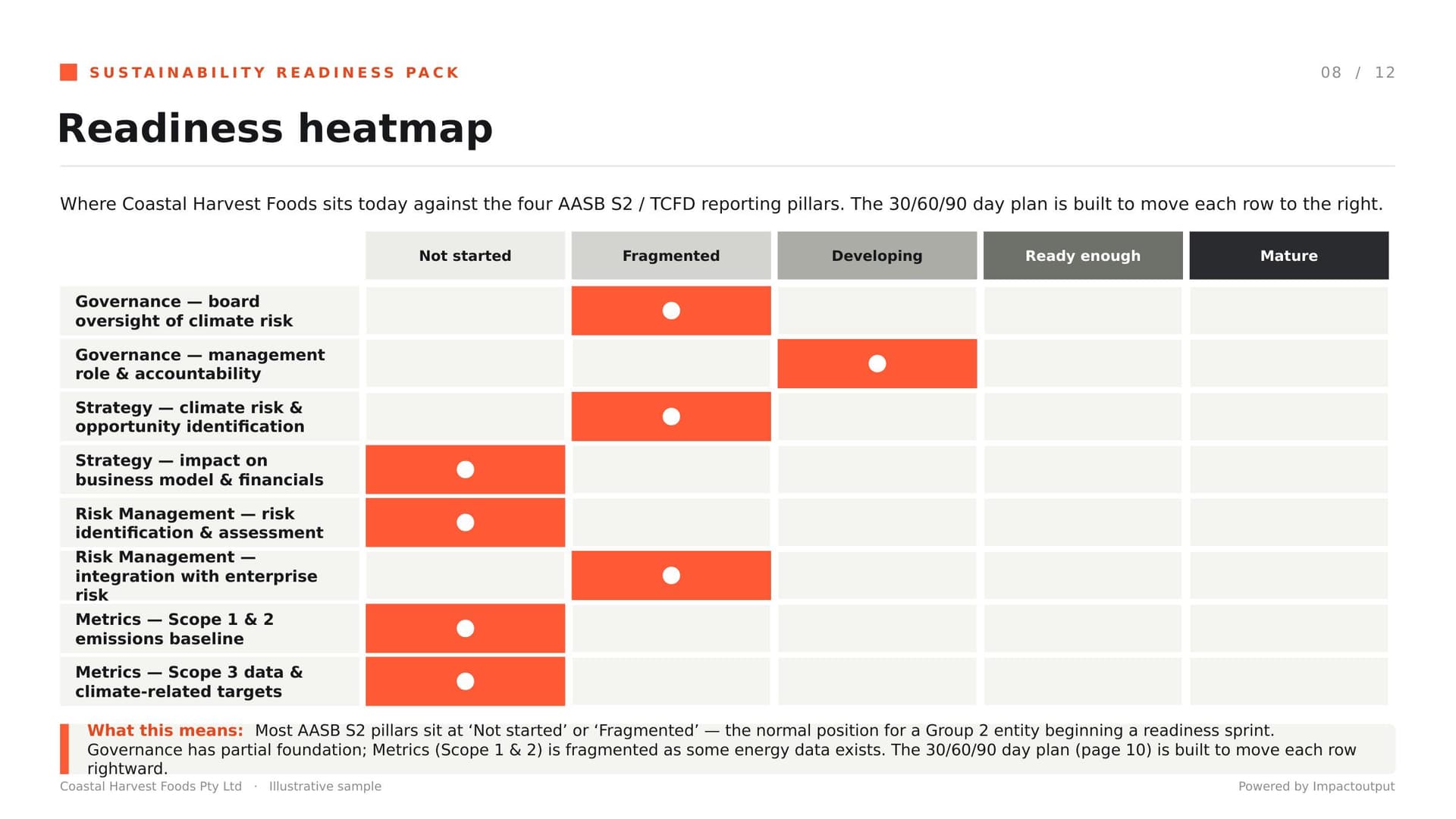
Readiness heatmap
A one-page view of where you sit today against the applicable reporting pillars, calibrated to your current maturity.
30 / 60 / 90 day action plan
A sequenced plan with owners and priorities, ready to put in front of an executive team without rewriting.
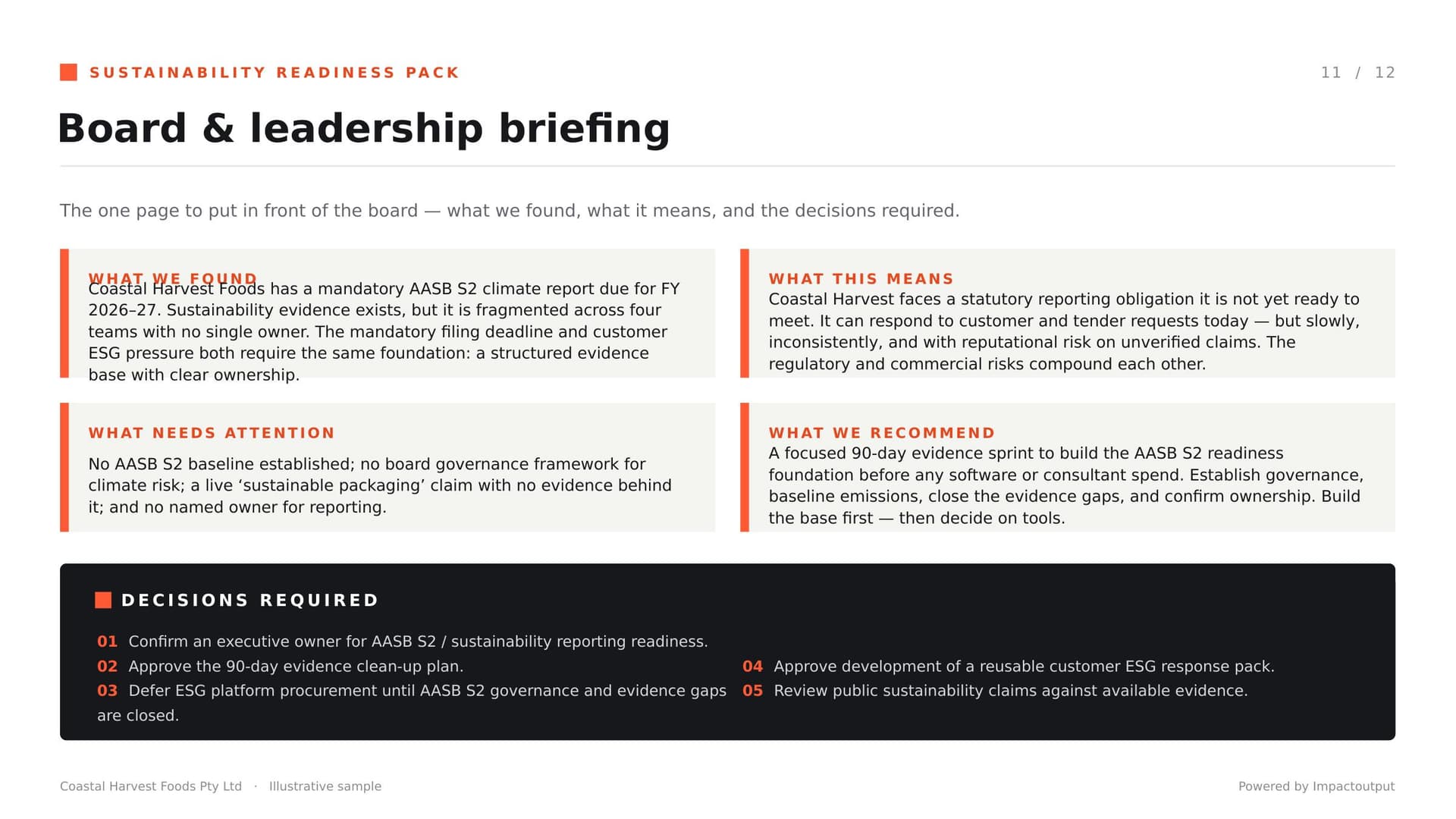
Board and leadership briefing pack
Evidence-backed, concise, designed for the board table. The document most CFOs are actually buying when they engage us.
Software & adviser pathway
Vendor-neutral guidance on whether and when to engage platforms or specialists — and which type fits your current situation.
Sample output
What it looks like
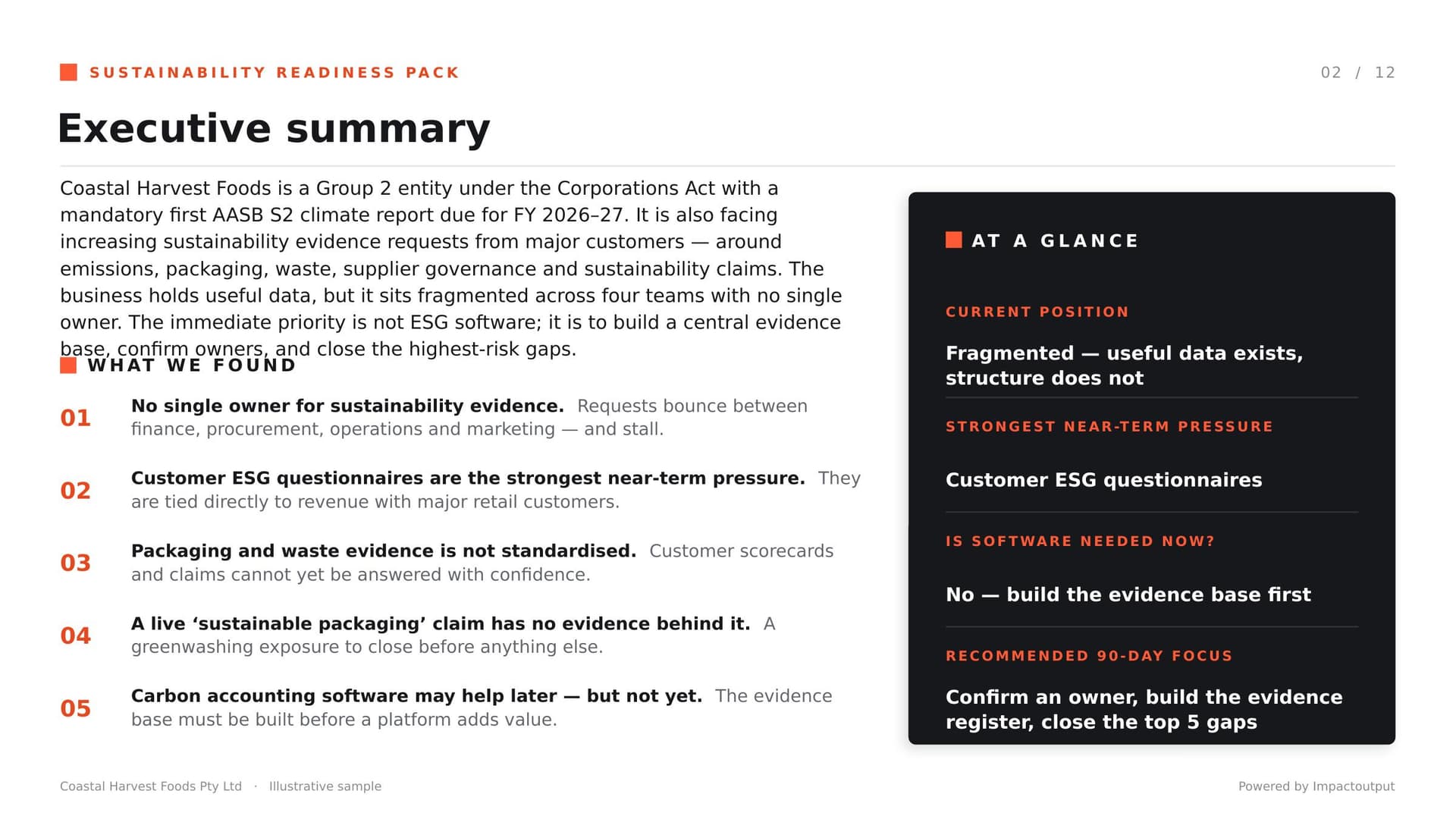
The slides below are from an illustrative readiness pack prepared for a fictional mid-market food and agriculture business. They show the structure and depth of what you receive — not a generic template.
Investment
Fixed fee. Defined scope. No open-ended engagement.
The diagnostic is free. The Readiness Sprint is a fixed-fee engagement — indicative investment is A$7,500–$15,000 for a single mid-market entity, confirmed at the strategy call based on entity complexity and number of frameworks in scope.
For accounting and advisory firms deploying the diagnostic across multiple clients, white-label arrangements are available.
Scope
When we are not the right fit
If your organisation already has an internal ESG team with established reporting processes, you are better served going directly to carbon accounting software or a specialist adviser. If you are a small business with no regulatory exposure and no customer pressure, the diagnostic may tell you that you do not need to act yet.
The Readiness Sprint does not replace specialist climate risk assessment, legal advice, emissions measurement, assurance, or ongoing annual reporting support. It defines the foundation and the sequence — and makes those downstream specialists more effective.
We would rather tell you that in ten minutes than have you spend money finding out later.
Ready to know where you stand?
Start with the free diagnostic. Results in your inbox in 10–15 minutes.
Start the free diagnostic →